How does the proper placement of cleaning points in production eliminate unnecessary steps for operators?
Efficient production inevitably requires the optimisation of practically everything - from production processes, costs and supply chains, through energy consumption, up to maintenance and cleanliness. Even the layout of cleaning points themselves can enhance the efficiency of both maintenance and the cleaning of the premises. This involves well-thought-out approaches that lead to improved workplace ergonomics, lean manufacturing and a more efficient organisation of cleaning.
Why are unnecessary steps a problem?
Just as efficient production without unnecessary steps is essential, so do maintenance and cleaning play a similarly important role.
The entire process involves a number of different tasks that the operator must perform. If their tools and equipment are not positioned strategically, they may end up taking an unnecessary number of steps, even hundreds of metres in a single day. This ultimately means:
- waste of time,
- lower productivity,
- increased fatigue of employees,
- increased costs.
How does the proper placement of cleaning points eliminate unnecessary steps?
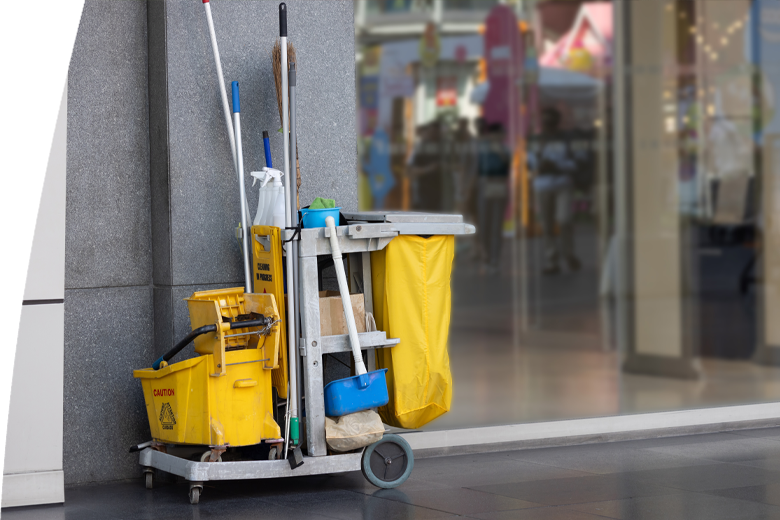
A cleaning point - that is, the place where cleaning tools and equipment are stored - should be situated in the immediate surroundings of the production process. This enables the operator to clean and maintain the work area on a continual basis and thus keeping it in perfect condition, thereby preventing potential accidents, unnecessary production downtime and the accumulation of waste, that often represents an obstacle to work.
Less searching, more work
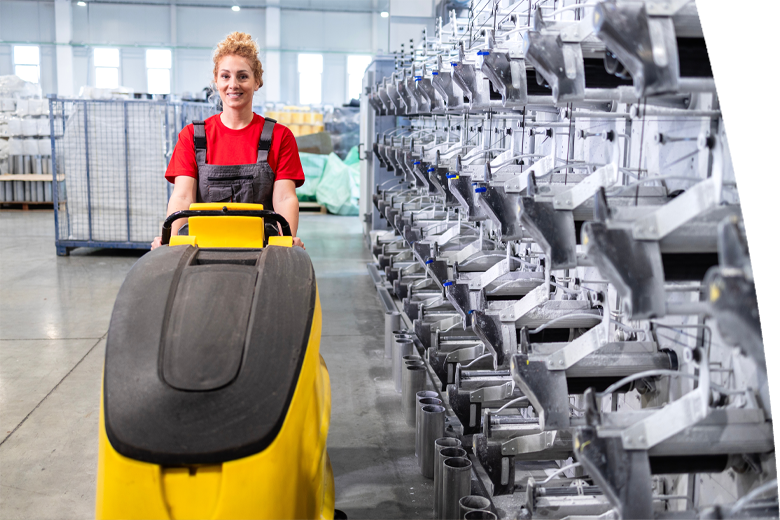
A common problem is not only the distance to the cleaning point, but also the fact that the cleaning equipment does not have a fixed storage place. This means that employees waste time looking for particular tools or trying to find out who used them last.
That is why visual marking of cleaning points is used in manufacturing companies. Each tool has its own precisely defined place, often marked by outlines or coloured markings. The operator can immediately see where the broom, mop or shovel is located, and can easily return them to their proper place after being used.
Cleaning points must copy the production process
When positioning them, it is insufficient to just distribute the equipment evenly throughout the hall. It is essential to analyse where the most dirt accumulates and what type of waste is generated at each individual workspace.
For instance:
- when cutting materials, sawdust or shavings are produced
- during packaging, cardboard boxes, plastic film and plastic tape accumulate
- during assembling, small metal or plastic remains may be left behind
Every workplace thus needs cleaning equipment that meets its specific requirements. Thanks to this, staff do not have to go to other areas of the production facility to get appropriate equipment.
Put the 5S method into practice
The Japanese 5S method is a five-point system ensuring quality, safety, and efficiency of the entire process.
- Seiri (sorting) - removing everything unnecessary from the workplace so that only the most essential items remain there.
- Seiton (systematising) - arranging and organising items so that they are logically positioned and easily accessible.
- Seiso (cleaning) - maintaining cleanliness, removing unnecessary waste from the workplace and contributing to a pleasant, well-organised environment.
- Seiketsu (standardisation) - this involves establishing processes and standards that staff must adhere to in order to ensure smooth operations and safety in the workplace.
- Shitsuke (self-discipline) - this is strongly related to the previous point. It is immensely important that employees themselves respect standards and processes. It is about accepting existing standards and following them.